

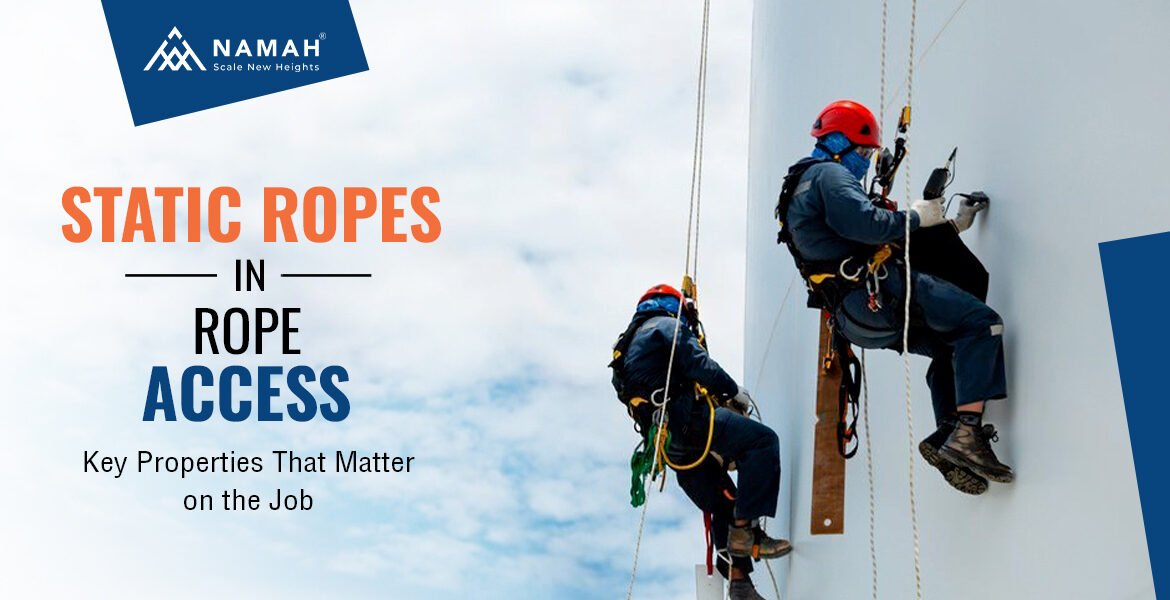
Anyone who has worked in rope access knows the quiet moment before stepping over the edge. The harness is secured, anchors are double-checked, tools are clipped in place, and the rope runs through the descender. At that moment, the rope becomes more than equipment. It becomes the line that carries trust, training, and experience.
For technicians working hundreds of feet above the ground, rope behavior matters as much as rope strength. This is where static ropes in rope access play a critical role. These ropes are designed for stability rather than elasticity, allowing workers to descend, position themselves, and perform technical tasks with precision.
Unlike dynamic climbing ropes, which stretch to absorb falls, static ropes are engineered to remain stable under load. That stability allows rope access technicians to work comfortably while maintaining predictable movement along the rope system.
Why Stability Matters in Rope Access Work
Rope access work rarely involves dramatic movement. More often, it involves careful positioning and deliberate motion. A technician might spend hours inspecting structural joints on a bridge, installing equipment on a wind turbine, or repairing façade panels on a high-rise building.
In these situations, rope stretch can quickly become a problem. Even small amounts of rope elongation can make positioning difficult, especially when tools and equipment are involved. This is why industrial rope access safety systems rely heavily on ropes that maintain consistent length and predictable tension under load.
Static ropes allow technicians to move smoothly while keeping their working position steady. The rope supports both the worker and the system of devices attached to it, from descenders to backup fall arrest equipment.
The Engineering Behind Rope Access Performance
To someone outside the industry, ropes may look similar. But rope access professionals understand that subtle differences in construction determine how ropes behave during real work conditions.
The most important factor is controlled elongation. Static ropes are designed to stretch very little, allowing technicians to maintain stable positioning during tasks that require precision.
Namah’s Indus Semi-Static Rope range is built with this balance in mind. These ropes provide low elongation while maintaining smooth handling during long descents and repeated use in vertical environments.
🔗 Indus Semi-Static Ropes
https://www.namahropes.com/product-category/semi-static-ropes/
Beyond elongation, durability also plays a major role in rope access performance. Technicians frequently work near steel structures, concrete surfaces, and mechanical systems that can create friction points along the rope.
Strong sheath construction protects the internal fibers from abrasion, helping the rope maintain its structural integrity during repeated use.
Handling Matters as Much as Strength
A rope can meet all technical specifications and still be frustrating to use if it handles poorly. Rope access work often requires managing descenders, ascenders, and backup devices simultaneously, sometimes while wearing gloves or working in challenging weather conditions.
Ropes that remain flexible and smooth under these conditions allow technicians to move more efficiently. Over time, however, moisture and environmental exposure can affect rope handling.
Namah’s AquaBloc water-resistant rope technology helps reduce water absorption, preserving rope flexibility even after repeated exposure to humid or outdoor environments.
🔗 AquaBloc Technology
https://www.namahropes.com/dry-treatment-climbing-rope-guide/
For technicians working on offshore platforms, coastal structures, or outdoor industrial facilities, maintaining rope performance in these conditions becomes essential.
Strength Is Only Part of the Equation
While rope strength is important, it is not the only measure of safety. In rope access systems, ropes must work seamlessly with mechanical devices such as descenders and fall-arrest systems.
This compatibility is why EN-certified rope access ropes are widely used across professional rope access operations. Certification ensures that ropes meet tested standards for strength, diameter consistency, and performance under load.
These standards also ensure that the rope functions correctly with rope access hardware used in professional systems.
Redundancy: The Principle That Defines Rope Access
One of the defining features of rope access work is redundancy. Technicians rarely rely on a single rope. Instead, they operate using two independent lines: a working rope and a backup safety rope.
This system ensures that even if one rope becomes compromised, the second rope prevents a fall. Proper rope selection and maintenance therefore, play a critical role in maintaining industrial rope access safety.
When static ropes are used correctly within this system, technicians benefit from both stability and security.
Choosing the Right Rope for the Work Ahead
Selecting ropes for rope access work requires more than simply choosing the strongest option available. The rope must perform reliably in the specific environment where it will be used.
Factors such as abrasion, moisture exposure, repeated load cycles, and equipment compatibility all influence rope performance.
Namah’s rope engineering focuses on balancing durability, handling, and structural stability. These qualities allow technicians using static ropes in rope access systems to focus on their work rather than worrying about equipment behaviour.
Closing Thoughts
Rope access work is built on trust. Technicians trust their training, their equipment, and the systems that keep them safe at height. Among those systems, the rope remains the quiet constant supporting every movement.
Understanding the properties that define reliable static ropes helps professionals choose equipment that performs consistently day after day. When ropes are designed for stability, inspected carefully, and used within well-structured systems, they become dependable tools rather than potential risks.
For professionals working in vertical environments, that reliability is what allows them to focus on the task at hand while knowing the system supporting them is built to perform.