

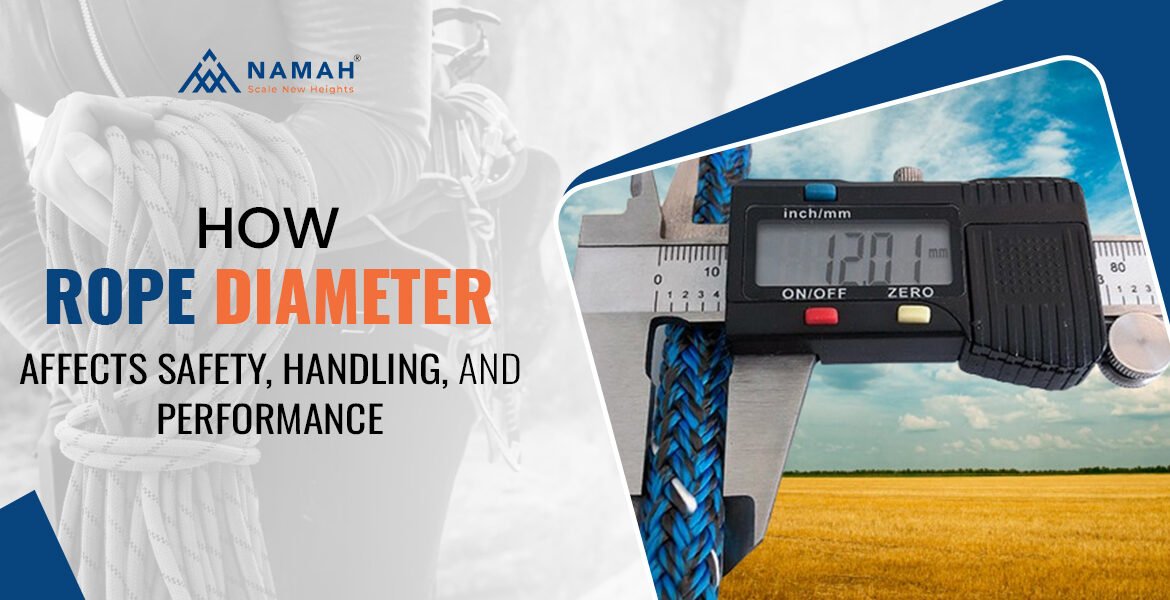
The first time you hold two ropes of different diameters side by side, the difference seems obvious. One feels lighter, faster through the hands. The other feels solid, almost reassuring. But what’s less obvious is how that difference plays out when you are actually on the wall or suspended at height, relying on the rope to behave exactly as expected.
Over time, most professionals realise that diameter is not just a specification on a product sheet. It shapes how the rope handles, how it performs under load, and how safely it integrates into a system. Understanding rope diameter in climbing and industrial use is less about numbers and more about behaviour in real conditions.
Why Diameter Is More Than Just Thickness
It is easy to assume that a thicker rope is always stronger and a thinner rope is always lighter. While that is partly true, the reality is more nuanced.
Diameter influences how a rope interacts with devices, how it absorbs friction, and how it responds under tension. In practical terms, it affects how confidently you can grip it, how smoothly it runs through hardware, and how it performs over time.
The rope diameter’s impact on safety becomes clear when ropes are used outside their intended range. A rope that is too thin for a device may slip unpredictably. A rope that is too thick may not feed properly, increasing friction and making controlled movement harder.
Handling: What You Feel Matters
Anyone who has spent time working on ropes knows that handling is not a minor detail. It affects every movement, from belaying to controlled descents.
Thinner ropes tend to move faster through devices. They feel lighter, which can be an advantage in climbing scenarios where reducing weight matters. However, they require more precise control, especially when managing slack or operating with gloves.
Thicker ropes, on the other hand, offer a more substantial grip. They feel easier to control, particularly for beginners or in high-use environments such as climbing gyms. This is one of the key rope diameter handling differences that becomes noticeable over time.
Namah’s Lynx Dynamic Rope range is designed to balance diameter with smooth handling, ensuring consistent control without compromising performance.
🔗 Lynx Dynamic Rope
https://www.namahropes.com/dynamic-ropes/
Safety: Where Diameter Becomes Critical
In safety systems, rope behaviour under load matters more than anything else. Diameter plays a direct role in how forces are distributed and how equipment interacts with the rope.
The rope diameter impact on safety is especially relevant in:
- Belay systems
- Rope access setups
- Fall arrest systems
A rope that is too thin may reduce friction in devices, increasing the risk of uncontrolled movement. A rope that is too thick may not function smoothly with certain equipment, affecting performance during critical operations.
In industrial environments, selecting the correct rope thickness for rope access ensures compatibility with descenders, ascenders, and backup devices. This compatibility is essential for maintaining predictable system behaviour.
Namah’s Indus Semi-Static Rope range is engineered with diameter consistency to support safe and stable rope access operations.
🔗 Indus Semi-Static Rope
https://www.namahropes.com/product-category/semi-static-ropes/
Performance Over Time
Rope performance is not just about how it behaves on day one. It is about how it continues to perform after repeated use, exposure, and stress.
Thinner ropes may wear faster under heavy use, especially in environments with high abrasion. Thicker ropes generally offer better durability but may feel heavier and slightly less responsive in certain applications.
Over time, factors such as moisture absorption can also affect performance. Ropes exposed to wet conditions may stiffen or lose flexibility if not properly treated.
Matching Diameter to Application
Choosing the right rope diameter isn’t just a matter of preference — it directly affects safety, durability, handling, and the margin of error in the environment you’re climbing or working in. Different scenarios demand different performance characteristics, and rope diameter is one of the easiest ways to make sure your rope is doing exactly what the job requires.
Below are common applications and real-life scenarios where diameter truly matters:
1. Sport Climbing (9.2 mm – 9.8 mm)
Sport routes typically involve repeated falls, heavy dogging, and lots of lowering, which means the rope takes frequent impacts and abrasion.
Why this range works:
- Thicker sheaths improve lifespan on rough limestone/granite
- Better heat management during repeated lowering
- Feeds smoothly through common belay devices like the GriGri, ATCs, and Smart 2.0
Real Scenario:
A climber projecting a 25-meter limestone route in Kalymnos will probably take 10–20 mini-falls per session. A 9.5 mm rope provides the right balance of durability and soft catch while avoiding excess weight.
Rope in use:
- Namah Lynx 9.5 mm: Ideal for hard redpoints and performance-focused sport climbers
2. Multi-Pitch & Alpine (8.3 mm – 9.0 mm)
Long routes demand ropes that are lightweight, packable, and efficient over distance.
Why this range works:
- Reduces rope drag on wandering pitches
- Lower weight reduces fatigue
- Thinner ropes provide smoother handling during complex rope work
Real Scenario:
On a 14-pitch granite route in Chamonix, weight matters. A pair of 8.4 mm half ropes gives climbers:
- Safer belaying on traverses
- Redundancy in case of rockfall
- 60m abseils by joining the ropes
Rope in use:
- Namah Genius 8.4 mm (AquaBloc for alpine/ice): Ideal for mixed terrain, snow, and big mountains.
3. Ice Climbing & Mixed (8.0 mm – 8.8 mm)
Ice and mixed climbing demand ropes that handle water, resist freezing, and maintain flexibility in sub-zero conditions.
Why this range works:
- Thin ropes reduce penetration drag in frozen conditions
- Certified dry treatments (like AquaBloc) prevent freezing
- Easier handling with gloves
Real Scenario:
On a WI5 route in Ouray or Sikkim, a pair of 8.4 mm dry-treated ropes stays flexible and resists moisture penetration even after repeated dunking in meltwater.
Rope in use:
- Namah Genius 8.4 mm AquaBloc – Dry-treated for extreme ice environments.
4. Trad Climbing (8.7 mm – 9.6 mm)
Trad routes often wander and require careful rope management to avoid drag.
Why this range works:
- Mid-diameter ropes balance durability & reduced drag
- Softer handling for complex placements
- Suitable for half or twin configurations, depending on terrain
Real Scenario:
A climber on a 45-meter wandering crack in Allgäu or Squamish will appreciate how an 8.9–9.2 mm rope reduces drag where protection zig-zags.
Rope in use:
- Namah Lynx 9.2 mm – Versatile for long trad routes
5. Big Wall & Hauling (9.8 mm – 10.2 mm)
Big walls punish ropes with friction, continuous hauling, and exposure.
Why this range works:
- Thick sheaths resist sharp-edge abrasion
- Higher core mass handles heavy hauling loads
- Better long-term durability than granite
Real Scenario:
On a multi-day El Cap route, a 10.0 mm static haul line paired with a 9.8 mm lead rope ensures safety and lifespan; thin ropes simply wear out too fast under wall hauling.
6. Industrial Rope Access / Rescue (10.5 mm – 11.5 mm static)
These applications prioritize stability, low stretch, and secure handling under heavy loads.
Why this range works:
- High static strength for loads >250 kg
- Minimal elongation for precise work positioning
- Compatible with industrial ascenders, descenders, and backup devices
Real Scenario:
A rope access technician performing façade maintenance needs a 10.5 mm static rope, ensuring controlled descent, low bounce, and compatibility with industrial descent systems.
Rope in use:
- Namah Indus 10.5 mm Semi-Static rope (industrial grade)
The Balance Between Control and Efficiency
Every rope represents a balance between control and efficiency. Thinner ropes offer speed and reduced weight. Thicker ropes offer stability and durability.
The key is understanding how that balance affects real-world performance. The rope diameter handling differences between ropes become more noticeable during long climbs, extended descents, or repeated industrial use.
Professionals who understand these differences can make better decisions about equipment selection and system design.
Closing Thoughts
Rope diameter is often treated as a simple specification, but it influences nearly every aspect of rope performance. From handling and safety to long-term durability, diameter shapes how a rope behaves under real conditions.
Choosing the right diameter is not about preference. It is about understanding how the rope will be used and how it will perform within a system. When the diameter matches the application, the rope becomes easier to control, more reliable under load, and better suited to the demands of the environment.
In the end, the right rope does not stand out. It works quietly, consistently, and exactly as expected.