

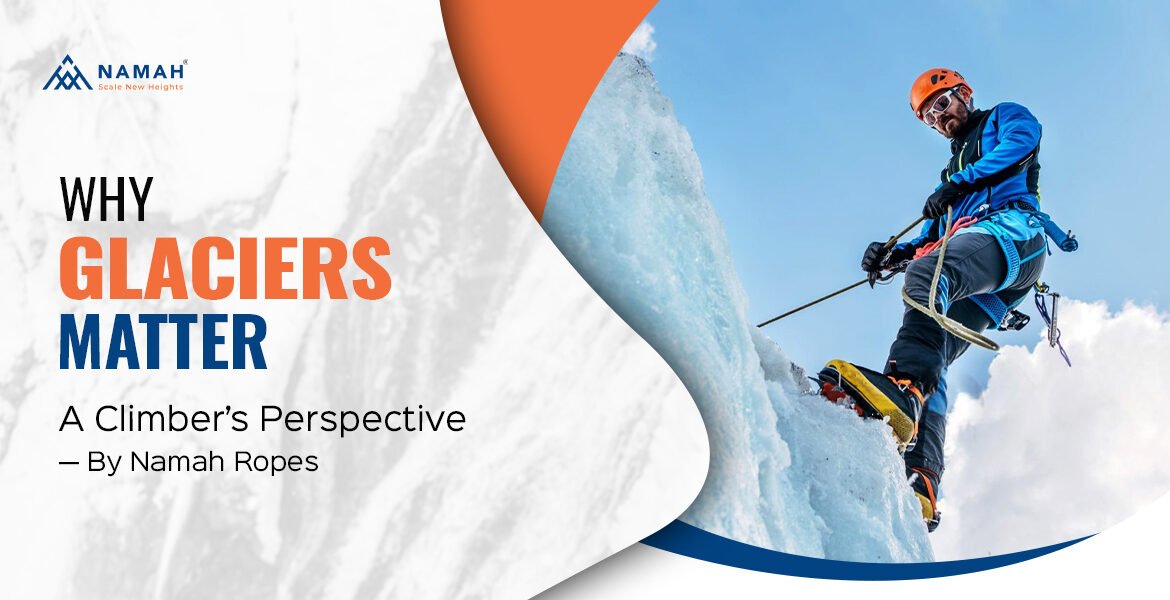
There’s a kind of stillness on a glacier that feels ancient; older than weather patterns, climbing grades, or the first lines ever drawn on a topo map. It’s a quiet that settles into you the moment your crampons bite into ice, reminding you that glaciers aren’t just part of the landscape; they are the architects of the mountains themselves.
As we celebrate International Mountain Day 2025, the global theme turns our attention to the fragile, powerful systems that make mountaineering possible, and glaciers sit at the heart of that story. They carve valleys, feed rivers, decide climbing seasons, reshape routes year after year, and demand a level of awareness that every alpinist learns early: respect the ice, or the mountains will teach you why.
For climbers, glaciers aren’t scenery. They’re moving, breathing entities that dictate safety, timing, technique, and teamwork. Step onto one, and everything sharpens: your ropework, your hearing, your trust in your team, and your trust in your gear. At Namah, our rope design philosophy begins exactly there. Glacier travel requires predictable stretch, glove-friendly handling, abrasion resistance on mixed terrain, clean feed in freezing conditions, and the kind of reliability that doesn’t flinch when temperatures drop.
This International Mountain Day, we honour not just the peaks we chase, but the ice that holds them together, and the climbers who choose to move responsibly across them.
How Glaciers Shape the Sport Itself
To understand glaciers and mountaineering, you have to understand that glaciers aren’t passive landscapes. They sculpt mountain faces, expose ridges, collapse seracs, and open or erase routes almost overnight. A glacier that felt straightforward one year may reveal a maze of crevasses the next. And every change affects the safety calculus: earlier starts, longer pitches, more conservative decisions.
The heart of the danger lies in what you can’t see. Beneath a thin crust of snow can sit a cavern large enough to swallow a bus. Every step is an argument with gravity. That’s why crevasse safety isn’t a chapter in a manual; it’s a mindset. And it’s why experienced mountaineers talk as much about rope choice as weather. You want a rope that stays flexible, resists micro-crystal abrasion, and maintains integrity even during intense rope handling in cold conditions. This is where Namah tests relentlessly, because glacier travel punishes gear in ways rock climbs never will.
A Landscape in Motion: What Science Says
Scientists tracking glaciers aren’t doing abstract work, they’re mapping the reality that climbers step into. In many ranges, ice loss is accelerating. Meltwater channels appear earlier. Snow bridges thin faster. Serac fall increases with temperature spikes. These changes amplify alpine climbing hazards in ways climbers feel under their boots long before the news catches up.
For mountaineers, science isn’t separate from the sport. It predicts the changing nature of glaciers and mountaineering itself. When ice retreats, classic routes shift and sometimes vanish. When the melt accelerates, fall factors increase. When crevasses widen earlier, crevasse safety protocols must evolve. And when conditions fluctuate wildly, glacier safety for climbers becomes not a checklist but a constantly adapting skillset.
At Namah, these scientific shifts influence how we build ropes sheaths that glide even on coarse ice crystals, cores that respond predictably under load, and fibers that maintain performance despite extreme rope handling in cold conditions.
Safety: The Quiet Rules Climbers Carry Inside
To a new climber, glacier travel looks like a series of techniques. To an experienced team, it’s a series of quiet agreements: tighten the rope here, soften your steps there, stop talking when the snow sounds hollow. These instincts keep you alive when alpine climbing hazards multiply unexpectedly.
But instinct needs equipment that behaves predictably. That’s why trusted ropes matter more in glacial terrain than almost anywhere else. Falling into a crevasse is violent; hauling someone out is exhausting; anchoring in shifting snow feels like building trust in real time with your gear. Good rope performance becomes a form of glacier safety for climbers, and poor performance becomes a liability.
Namah’s glacier-ready dynamic and semi-static ropes are tuned for exactly this kind of calm reliability. Their handling stays smooth when temperatures drop. They resist sheath stiffening, allowing clean knots even after hours of exposure. And their behavior during rope handling in cold conditions remains stable enough for tired hands to trust.
A Climber’s Emotional Truth
Ask any climber what they remember from their first glacier crossing, and they never talk about the summit. They talk about the feeling of stepping over a thin snow bridge. The moment they heard ice shift far below. The weight of knowing that glaciers and mountaineering are inseparable and that one mistake can rewrite a life.
Glaciers teach patience, communication, and humility. They teach that crevasse safety is not something you “know” but something you practice every single step. They teach that alpine climbing hazards don’t announce themselves. And above all, they teach responsibility: your choices affect your rope team as much as yourself.
On International Mountain Day, this emotional thread matters. It reminds climbers why they tie in, why they double-check knots, why the rope between two people carries more than physical load; it carries trust.
Why Glaciers Still Matter, and Always Will
Glaciers store water for billions. They regulate the climate. They shape mountains in slow-motion. But to the climbing world, they also shape character. They demand competence, self-awareness, and a commitment to safety that doesn’t disappear once the rope is coiled.
This is why glacier safety for climbers remains a cornerstone of training, and why glaciers and mountaineering will always be intertwined. It’s also why we build ropes at Namah the way we do: with respect for terrain that is ancient, unstable, and profoundly beautiful.
Whether you climb in the Andes, the Alps, or the Himalaya, you’ll face alpine climbing hazards that force you to really listen to the ice beneath your feet. When you do, you’ll understand why glaciers matter not just to science or sport, but to the soul of every climber who has ever stepped onto a shifting world of blue ice.