

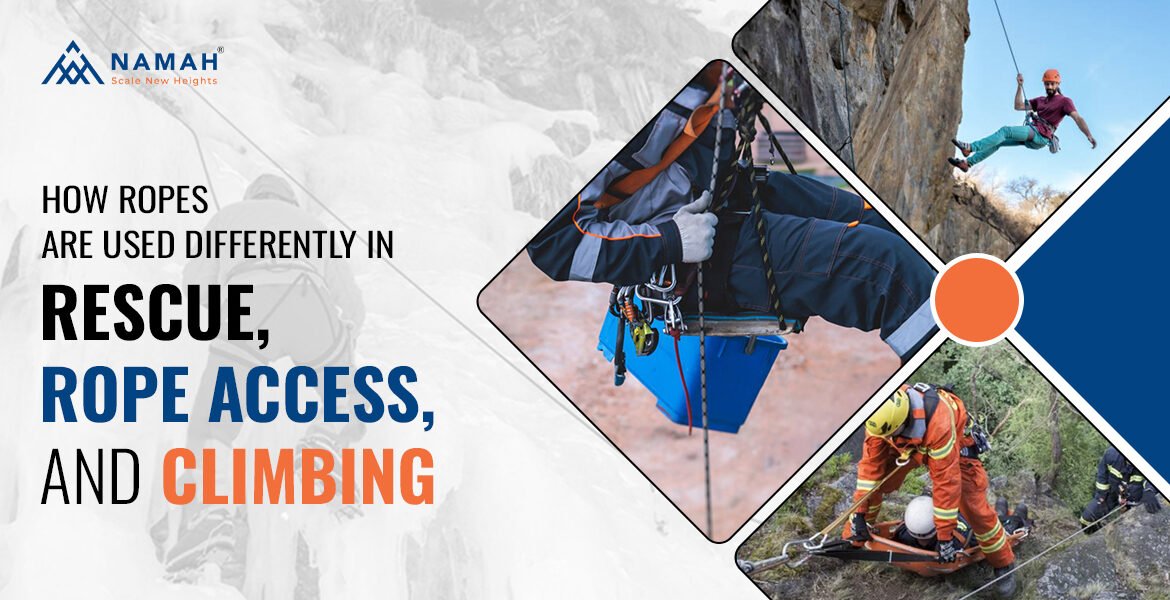
There is a moment, just before the rope takes weight, where everything pauses.
In climbing, it might be the instant before committing to a move above your last protection. In rope access, it is the step over the edge, trusting the system beneath you. In rescue, it is quieter but heavier the moment when someone else’s safety depends on how that rope performs.
The rope is the same object in all three situations. But what it is expected to do changes completely.
Understanding how ropes are used in rescue rope access and climbing is not about comparing techniques. It is about recognising how purpose reshapes behaviour how the same equipment adapts to different environments, risks, and responsibilities.
The Difference Begins with Responsibility
The role of the rope is defined by who or what it is supporting.
In climbing, the rope primarily protects the climber from a fall. It is part of a dynamic system built around movement, progression, and controlled risk.
In rope access, the rope becomes a working line. It supports positioning, descent, and stability while tasks are performed at height.
In rescue, the rope carries the highest level of responsibility. It is not just supporting movement or positioning it is part of a system designed to recover, lower, or raise another person safely, often under time pressure.
This shift in responsibility is what shapes how ropes are used in rescue rope access and climbing across real-world scenarios.
Climbing: Built Around Movement and Falls
Climbing ropes are designed to move.
They run through belay devices, respond quickly to slack, and most importantly, stretch under load. This stretch absorbs the energy of a fall, reducing impact forces on both the climber and the anchor system.
This is one of the defining differences in rope usage: climbing vs rescue vs industrial environments. In climbing, the rope is expected to handle sudden force and dynamic movement.
Handling also plays a key role. Climbers rely on ropes that feed smoothly, knot easily, and remain responsive during complex sequences.
Namah’s Lynx Dynamic Rope (https://www.namahropes.com/dynamic-ropes/) reflects this requirement. It is designed for controlled stretch and fluid handling, supporting climbers in situations where movement and responsiveness are essential.
Rope Access: Stability Over Movement
In rope access work, movement is controlled rather than reactive.
Technicians descend structures, position themselves precisely, and often remain suspended for extended periods while performing tasks. In this environment, excessive stretch becomes a problem rather than a benefit.
This is where the difference between static and dynamic ropes in rescue and access becomes clear. Rope access systems rely on static or semi-static ropes that maintain their length under load, allowing for predictable movement.
Stability is critical. Even small variations in rope behaviour can affect positioning, especially when tools and equipment are involved.
Namah’s Indus Semi-Static Rope (https://www.namahropes.com/product-category/semi-static-ropes/) range is designed for this kind of application, focusing on low elongation and consistent handling during repeated descents.
In rope access, the rope is not just supporting weight, it is supporting precision.
Rescue: Control Under Pressure
Rescue environments bring a different kind of demand.
Unlike climbing or rope access, rescue systems often involve raising or lowering another person, sometimes in unpredictable conditions. Loads can vary, systems can become complex, and decisions often need to be made quickly.
This is where rescue rope system differences become most apparent.
Rescue ropes are typically static or low-stretch, similar to rope access ropes, but the systems they are used in are more dynamic in structure. Mechanical advantage systems, pulleys, and multiple anchor points are often involved.
The rope must:
- handle higher combined loads
- remain stable during lifting and lowering
- integrate smoothly with multiple devices
In these situations, the rope is part of a larger system where control matters more than speed, and predictability matters more than flexibility.
Systems Define Behaviour
One of the most important distinctions is that ropes do not function in isolation.
In climbing, the rope works with belay devices and protection points. The system is relatively simple but must respond dynamically.
In rope access, the system becomes more structured, with descenders, backup devices, anchors, and safety lines all working together. Redundancy is built into the system.
In rescue, the system becomes even more complex. Multiple ropes, pulleys, anchors, and personnel may be involved at the same time.
This is why understanding how ropes are used in rescue rope access and climbing requires looking beyond the rope itself. The system defines how the rope behaves.
Load and Weight Considerations
Load expectations also differ significantly.
Climbing ropes are primarily designed to handle the weight of one climber and the forces generated during a fall.
Rope access ropes support a technician along with tools and equipment, often under continuous load for extended periods.
Rescue ropes may carry the weight of multiple people, especially during stretcher operations or assisted rescues.
These differences in rope usage, climbing vs rescue vs industrial scenarios, influence how ropes are constructed, tested, and used in practice.
Handling and Fatigue Over Time
Another often overlooked factor is how ropes behave over time.
In climbing, ropes are used in bursts, climbs, rests, and repeated attempts. Handling remains important, but exposure is intermittent.
In rope access and rescue, ropes are often in continuous use. They must maintain flexibility, resist abrasion, and perform consistently even after repeated cycles of loading and environmental exposure.
This is where material design and construction quality become critical. Over time, small changes in flexibility or diameter can affect system performance.
The Balance Between Flexibility and Control
Climbing prioritises flexibility. Rope access prioritises control. Rescue demands both, but under stricter conditions.
The difference between static and dynamic ropes in rescue and access highlights this balance. Too much stretch reduces control. Too little stretch increases force.
Choosing the right rope is about matching behaviour to application, understanding what the rope is expected to do before it is ever used.
When Roles Overlap
There are situations where these worlds intersect.
A rescue operation on a cliff may involve climbing techniques. Rope access technicians may assist in rescue scenarios. Climbers may need to perform self-rescue.
In these moments, understanding the differences in the rescue rope system becomes essential. Using the wrong type of rope or system can change how forces are distributed and how safely the operation is carried out.
The rope itself does not change. But the way it is used does.
Closing Thoughts
Ropes are often seen as simple tools. But their role is defined by context.
In climbing, they absorb movement and protect against falls. In rope access, they provide stability and control. In rescue, they become part of a system designed to protect not just the user, but someone else as well.
Understanding how ropes are used in rescue rope access and climbing is about recognising these shifts in responsibility, behaviour, and system design.
Namah’s approach reflects this understanding, building ropes that are not just strong, but consistent in how they perform across different environments.
Because in the end, a rope is not defined by how it looks in your hands, but by how it behaves when everything depends on it.