

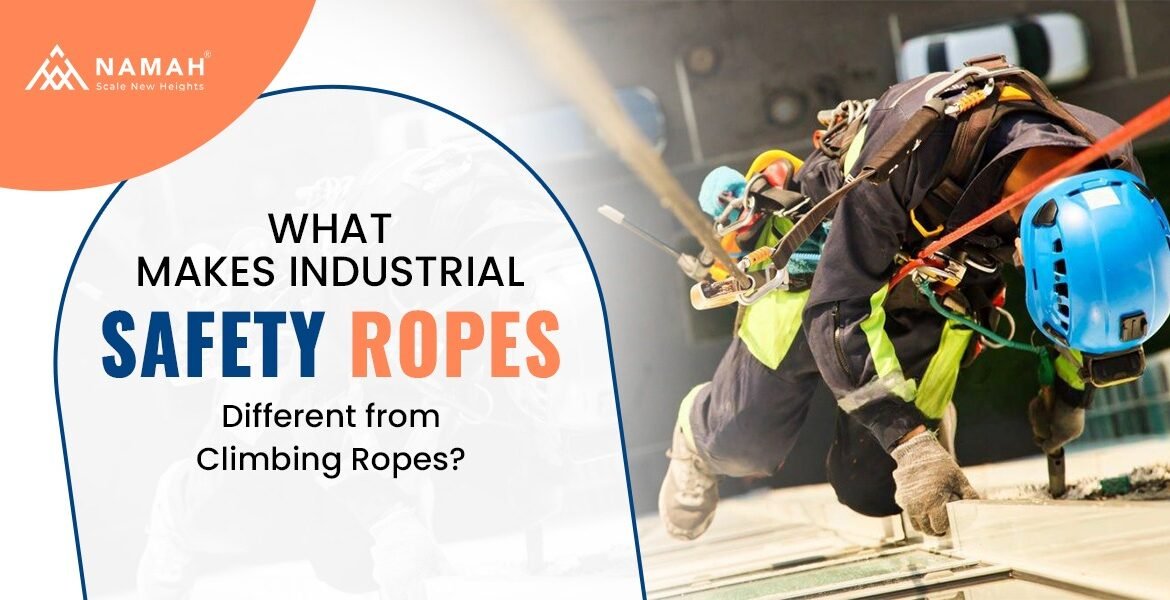
There’s a moment that most people don’t think about until they experience it firsthand.
It’s the moment when you are suspended on a rope, whether halfway up a rock face or several floors above the ground on a building façade. The rope is no longer just equipment. It becomes the single line connecting you to stability, movement, and safety.
From the outside, ropes used in these situations can look almost identical. Similar diameter, similar texture, similar construction. But once they are placed under real conditions, the difference becomes impossible to ignore.
A climber falling onto a rope and a technician descending a structure are relying on systems that demand completely different responses. Understanding industrial safety ropes vs climbing ropes is not about comparing two products. It is about understanding how design changes when the risks, environments, and expectations shift.
Why the Difference Starts with Intent
Every rope is designed with a purpose in mind, and that purpose shapes how it behaves.
Climbing ropes are built for uncertainty. Routes are unpredictable, falls are expected, and the rope must respond dynamically to sudden force. Its primary role is to absorb energy and reduce impact.
Industrial ropes are built for control. In rope access work, the system is designed to prevent falls entirely. Movement is planned, positioning is precise, and the rope must remain stable under constant load.
This contrast defines industrial safety ropes vs climbing ropes at the most fundamental level. One is designed to react. The other is designed to remain consistent.
The Core Difference: Stretch vs Stability
The most noticeable difference lies in how these ropes behave under tension.
Dynamic climbing ropes are engineered to stretch. This stretch is not a flaw — it is a safety feature. It allows the rope to absorb the energy generated during a fall, reducing the force transmitted to the climber and the anchor.
Static or semi-static industrial ropes behave very differently. They are designed to stretch very little, allowing for controlled descents and stable positioning.
This is where the difference between static and dynamic ropes becomes critical in real-world use. A rope that stretches too much in an industrial setup can create instability, making it difficult to maintain position or control movement.
In rope access environments where precision matters, Namah’s Indus range is designed to maintain that stability. The Indus Semi-Static Rope (https://www.namahropes.com/product-category/semi-static-ropes/) reflects this approach, low elongation, consistent handling, and predictable behaviour during repeated descents.
How Safety Systems Change the Role of the Rope
Climbing systems and industrial systems are built around very different safety philosophies.
In climbing, the rope plays a central role in fall protection. It is expected to take dynamic loads and perform under sudden stress.
In industrial environments, safety is built on redundancy. A technician typically works with two independent ropes:
- a working rope
- a backup safety rope
This system ensures that even if one rope is compromised, the second maintains protection.
Because of this, the rope safety standards for industrial use focus less on fall absorption and more on reliability under continuous load. The rope must integrate seamlessly with descenders, ascenders, and fall-arrest devices.
It is not just about strength. It is about how consistently the rope performs within a larger system.
Handling: The Difference You Feel Immediately
Handling is often where users first notice the difference.
Climbing ropes are designed for fluid movement. They move quickly through belay devices, allowing climbers to manage slack, clip protection, and respond to changing conditions.
Industrial ropes prioritise control over speed. Movement is slower, more deliberate, and easier to regulate. This becomes especially important when working at height for extended periods.
These differences are shaped by industrial rope construction features — from sheath design to diameter consistency. Every detail contributes to how the rope feels during use.
When compared to ropes designed for movement, like the Lynx Dynamic Rope (https://www.namahropes.com/dynamic-ropes/), the contrast becomes clearer. The Lynx range is built for responsiveness and smooth handling in climbing scenarios, where quick adjustments and dynamic movement are essential.
In industrial settings, that same responsiveness would feel unpredictable. Stability becomes far more valuable than speed.
Durability Under Continuous Exposure
Another important distinction lies in how these ropes are used over time.
Climbing ropes experience wear, but often in cycles, periods of use followed by rest. Even in demanding climbs, exposure is usually intermittent.
Industrial ropes operate in a completely different environment. They are exposed to:
- rough concrete edges
- steel structures
- dust and chemical contaminants
- Repeated friction from devices
This continuous exposure means that durability is not just a feature; it is a requirement.
When comparing industrial safety ropes vs climbing ropes, this difference becomes significant. Industrial ropes must maintain their performance even after prolonged use in abrasive conditions.
Over time, this affects not only the sheath but also the internal fibres, which is why inspection and material quality play a critical role.
Standards Reflect Real-World Risk
The way ropes are tested also reflects their intended use.
Climbing ropes are tested for dynamic performance, how they behave during falls, how much force they transmit, and how many falls they can withstand.
Industrial ropes are tested for consistency. The rope safety standards for industrial use ensure that ropes maintain structural integrity, low elongation, and compatibility with safety devices over time.
These standards are designed for environments where failure is not sudden but gradual, where performance must remain reliable across repeated use.
Predictability vs Adaptability
Climbing often involves adapting to changing conditions. Routes vary, movements are dynamic, and the rope must respond accordingly.
Industrial work is built around predictability. Every movement is controlled, and every system is designed to minimise variation.
This is why industrial safety ropes vs climbing ropes ultimately come down to behaviour over time. Industrial ropes are engineered to behave the same way, every time, regardless of how often they are used.
That consistency allows professionals to focus on their work without constantly adjusting to the equipment.
When the Wrong Rope Changes Everything
The difference becomes most important when the wrong rope is used in the wrong environment.
A dynamic rope in an industrial setup introduces unnecessary stretch, affecting positioning and control. A static rope used for climbing removes the ability to absorb fall energy, increasing impact forces.
The difference between static and dynamic ropes is not just a technical distinction. It defines the boundary between safe and unsafe use.
Closing Thoughts
At a glance, ropes may appear similar. But their behaviour tells a very different story.
Climbing ropes are designed to absorb movement, protect against falls, and adapt to dynamic conditions. Industrial ropes are designed to provide stability, maintain control, and perform consistently under continuous load.
Understanding industrial safety ropes vs climbing ropes is about recognising these differences before they matter in practice.
Namah’s approach to rope design reflects this quietly, focusing on how ropes perform in real environments, whether that means controlled stability in industrial settings or responsive handling in climbing applications.
In the end, the right rope does not need to prove itself. It simply works, consistently and reliably, exactly when it is needed.