

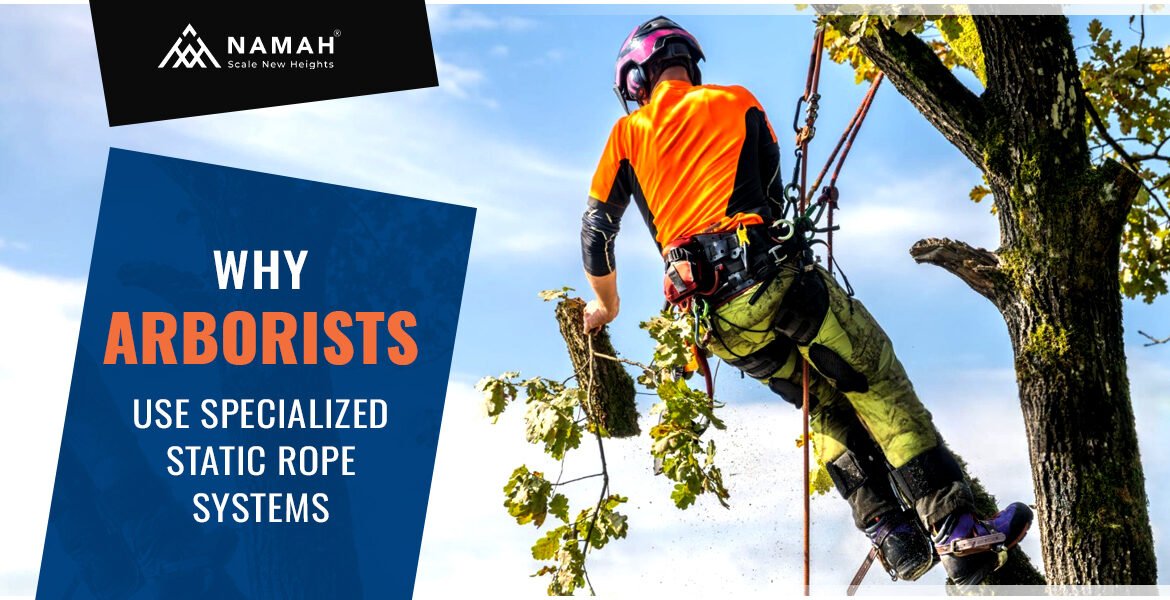
The rope is set, the anchor point is selected, and the route through the tree is planned not just upward, but across branches where work will actually happen. Unlike rock or steel structures, a tree is not fixed. It moves under load, shifts with position, and responds to every step the arborist takes.
In that environment, the rope is not just used to reach height. It becomes the most stable part of the system that the arborist relies on while climbing and working.
Understanding why arborists use specialized static rope systems starts here with the need for consistency and control in a structure that is constantly changing.
Stability in a Moving Environment
Branches flex under load. Surfaces create uneven friction. Even small movements, wind, weight shifts, and changing positions can affect how the system behaves. This is why arborist rope system requirements differ from those of other rope applications.
In climbing, the rope is designed to absorb dynamic forces from movement and falls. In arboriculture, the rope is expected to remain stable so the climber can manage movement within the canopy.
Static ropes make that possible. By limiting stretch, they reduce unnecessary movement and allow arborists to maintain control even when the tree itself is moving.
This is where static rope systems in arboriculture become essential. The rope provides a consistent line within a changing structure, helping the arborist move with intention rather than constantly adjusting to rope behaviour.
Precision Matters More Than Movement
Arborist work is not about reaching a point and stopping. It is about working within the canopy, pruning, cutting, inspecting, and rigging often while suspended in place.
In these situations, even small amounts of rope stretch can become noticeable. A slight drop in position, a delayed response under load, or constant micro-adjustments can make the work more difficult.
This is one of the most practical benefits of static ropes for tree climbing. They allow arborists to hold a position without continuous correction, making movement more efficient and predictable.
Over time, that predictability reduces fatigue and improves control. The rope is no longer something that needs to be managed constantly. It becomes something that simply works
Consistency Over Time and Use
Arborist rope systems are not used in short bursts. They are used continuously, ascending, repositioning, descending, and repeating the process throughout the day.
This repeated use introduces wear differently. The rope runs over bark, through redirects, and across natural surfaces that are rarely smooth or uniform.
Because of this, arborist rope system requirements go beyond basic strength. The rope must maintain its behaviour over time, consistent diameter, reliable handling, and abrasion resistance.
Ropes designed for stability, like the Indus Semi-Static Rope , align closely with these needs. Their low elongation and controlled handling support the kind of consistent performance arborists rely on during long working sessions.
Movement Within the Canopy
Unlike traditional climbing, arborist movement is rarely straight up and down.
Once inside the canopy, movement becomes lateral, diagonal, and constantly adjusted. The rope may run through multiple points, redirecting force as the arborist shifts position.
This is where the benefits of static ropes for tree climbing become even more apparent. A stable rope allows smoother transitions between positions, without the delay or bounce that a stretch can introduce.
At the same time, the rope must still handle well, tying knots, running through devices, and adjusting under load without becoming difficult to manage.
Why Dynamic Ropes Don’t Fit the Role
To understand why arborists use specialized static rope systems, it helps to compare them directly with dynamic ropes.
Dynamic ropes, like the Lynx Dynamic Rope , are engineered to stretch under load. This elongation absorbs the energy of a fall, reducing impact forces on the climber and the system. It’s a critical feature in climbing, where falls are expected and need to be managed safely.
Semi-static ropes, such as the Indus Semi-Static Rope , are built with a different purpose. They limit elongation, allowing the rope to remain stable under load. This makes movement more predictable and positioning more precise, which is essential in arborist work.
The difference becomes clearer when you look at how each rope behaves in practice:
- Elongation
- Dynamic ropes: High elongation to absorb fall energy
- Semi-static ropes: Low elongation for stability and control
- Primary Function
- Dynamic ropes: Fall protection in climbing systems
- Semi-static ropes: Positioning and controlled movement
- Handling Under Load
- Dynamic ropes: Responsive, with noticeable stretch and rebound
- Semi-static ropes: Firm and consistent, with minimal bounce
- Use Environment
- Dynamic ropes: Sport climbing, trad, and mountaineering
- Semi-static ropes: Rope access, arboriculture, rescue
From a technical perspective, this difference is reflected in their construction and performance characteristics.
Dynamic ropes are tested for:
- impact force reduction
- number of fall ratings
- dynamic elongation
Semi-static ropes are evaluated based on:
- low working elongation
- static strength
- Sheath durability under repeated friction
In arborist work, where climbing involves repeated ascent, lateral movement, and stable positioning within the canopy, dynamic elongation becomes a limitation rather than an advantage. The rope can feel less predictable, requiring constant adjustment during movement.
This is where semi-static construction becomes more suitable. The rope behaves consistently, allowing the arborist to focus on movement through the tree rather than compensating for rope stretch.
The difference, ultimately, is not about one rope being better than the other. It is about matching rope behaviour to the demands of the environment. Arborist systems prioritise control, efficiency, and predictability and that is exactly what semi-static ropes are designed to provide.
Control as a Form of Safety
Safety in arboriculture is not just about preventing falls. It is about maintaining control at all times.
A rope that behaves predictably allows arborists to anticipate movement, manage load, and work with confidence. Small inconsistencies, changes in stretch, handling, or friction can add up over time.
This is why static rope systems in arboriculture are not just a preference, but a requirement. They reduce variables in an already dynamic environment, making the system more reliable overall.
Closing Thoughts
Working in trees means working in a space that is always changing. The structure moves, the surfaces vary, and no two setups are ever the same.
In that setting, the rope becomes the one element that must remain consistent.
Understanding why arborists use specialized static rope systems is really about understanding this need for balance, bringing stability into an environment that does not naturally provide it.
Namah’s approach to rope design reflects this idea quietly, focusing on how ropes behave in real conditions rather than just how they are specified.
For an arborist, the rope is not just a tool for access. It is what makes controlled movement possible in a place where nothing else stays still.